A healthy Lilly Pilly hedge should normally have dense green foliage with colourful new growth. If the leaves start turning brown, curling, becoming distorted or entire sections of the hedge begin thinning out, something has changed. The important thing is not to assume that every brown Lilly Pilly needs more water.
In Sydney gardens, browning can be caused by Lilly Pilly psyllid, scale insects, sooty mould, water stress, poor drainage, root problems, nutrient deficiencies, fungal disease or simply the hedge's growing conditions. The appearance and location of the damage usually provide useful clues, so before treating the hedge, take a closer look at which leaves are affected, where the damage started and what the new growth looks like.
First: what does the damage actually look like? Brown, curled or distorted new leaves and raised pimples or bumps point to psyllid. Sticky leaves suggest scale or other sap-sucking insects, and a black coating over the foliage is sooty mould growing on their honeydew. Dry brown tips and margins indicate water or root stress; yellow leaves followed by browning suggest waterlogging, root problems or nutrition. Yellow or orange powdery spots and pustules can indicate Myrtle rust, while sudden browning after very hot weather is usually heat stress. One isolated section dying points to root damage or drainage, interior leaves browning while the exterior stays healthy is often normal shading, and large areas dying back means a significant root, disease or environmental problem.
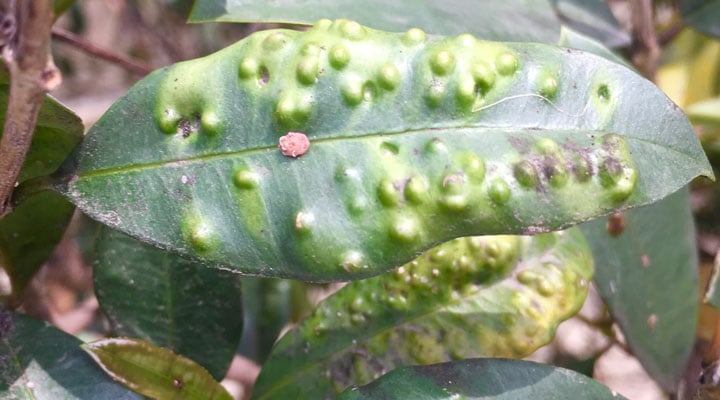
1. Lilly Pilly psyllid. One of the first things we look for on a distorted Lilly Pilly hedge in Sydney is psyllid damage. Psyllids are small sap-feeding insects, and their feeding on developing foliage causes characteristic distortion. Instead of opening into smooth, healthy foliage, affected leaves become puckered, curled, blistered, bumpy, red or bronze, then yellow and eventually brown. The damage can be particularly obvious on new growth.
What does psyllid damage look like? Look closely at the surface of the leaf. A psyllid-damaged leaf often has obvious raised pimples or blister-like bumps, and the leaf may become badly misshapen as it develops. This is very different from simple drought stress, where the leaf itself may remain relatively normal in shape but develop dry brown edges or tips.
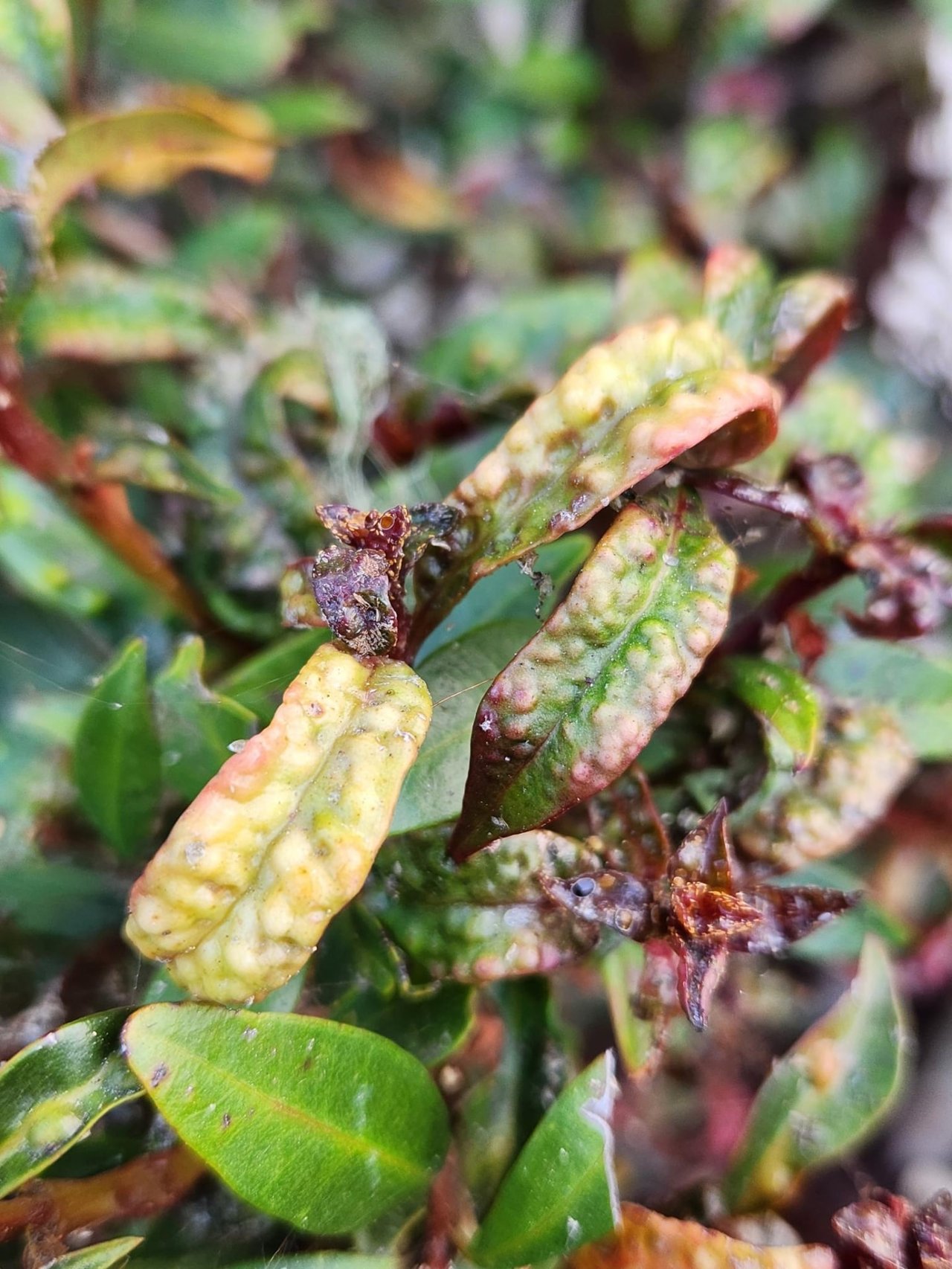
Why does psyllid keep coming back? Psyllid problems often become most noticeable during periods of active new growth. This matters because repeatedly trimming a hedge stimulates another flush of soft foliage, and if the pest is already present that fresh growth becomes another feeding opportunity. That doesn't mean you shouldn't trim the hedge — it means hedge trimming, plant health and pest management should be considered together, which is also why the timing of Lilly Pilly trimming is worth getting right.
How do we treat psyllid? Treatment depends on the severity of the problem, so start by assessing the new growth. If only a relatively small amount of foliage is affected, damaged growth can often be selectively removed. For a more significant infestation, an appropriate insect treatment may be required, with product choice based on the pest identified and the current Australian product label. Avoid spraying simply because the hedge looks brown — if the problem is actually root stress or drainage, an insecticide won't solve anything. After treatment, encourage healthy replacement foliage with appropriate watering, nutrition and mulch.
Will the damaged leaves become normal again? Usually not. Once a leaf has been badly distorted by psyllid feeding, the physical damage to that leaf remains. The aim of treatment is therefore to protect subsequent growth. Once the pest is controlled and the plant is growing strongly again, damaged foliage can gradually be removed as healthy new leaves replace it.
2. Scale insects. Scale is another common problem on established hedges. These sap-feeding insects attach themselves to stems and leaves and can be difficult to recognise because they don't necessarily look like conventional insects. Depending on the species, you may see small brown, white or grey bumps attached to stems or underneath leaves. Heavy infestations weaken the plant by feeding on its sap.
Signs of scale. Look for small bumps attached to stems or leaves, sticky foliage, ants moving through the hedge, yellowing leaves, reduced vigour and black sooty mould. The ants are a particularly useful clue: they may be attracted to honeydew, the sugary material produced by some sap-feeding insects. If a Lilly Pilly is covered in ants and sticky foliage, inspect it carefully for scale and other sap-feeding pests.
Treating scale. Light infestations can sometimes be reduced by removing heavily affected growth. More substantial infestations may require a horticultural oil or another product specifically registered for the pest and plant situation. Coverage matters — spraying only the visible outside of a dense hedge may miss insects living deeper inside the canopy and underneath the foliage. Always follow the current product label, including application rates, weather restrictions and repeat-treatment instructions.
3. Black leaves: sooty mould. If your Lilly Pilly appears to be turning black rather than brown, look closely at the leaf surface. Sooty mould forms a dark coating over foliage, but the mould itself is often secondary to the real problem: it grows on honeydew produced by sap-feeding insects such as scale. This is why simply washing or treating the black coating isn't enough — you need to identify what is producing the honeydew. The basic approach is to identify the sap-sucking pest, control it, and allow the sooty mould to disappear as clean new foliage develops. For smaller plants, some residue can also be physically washed from the foliage. A badly affected hedge can look terrible but may recover well once the underlying pest pressure is controlled.
4. Myrtle rust. Myrtle rust deserves particular attention because Lilly Pillies belong to the Myrtaceae family. The disease affects young foliage, shoots and other susceptible plant tissue, and unlike ordinary drought browning the early stages can produce distinctive spots and yellow to orange pustules. As infection progresses, foliage can become distorted and damaged, and susceptible plants may experience shoot dieback and defoliation.
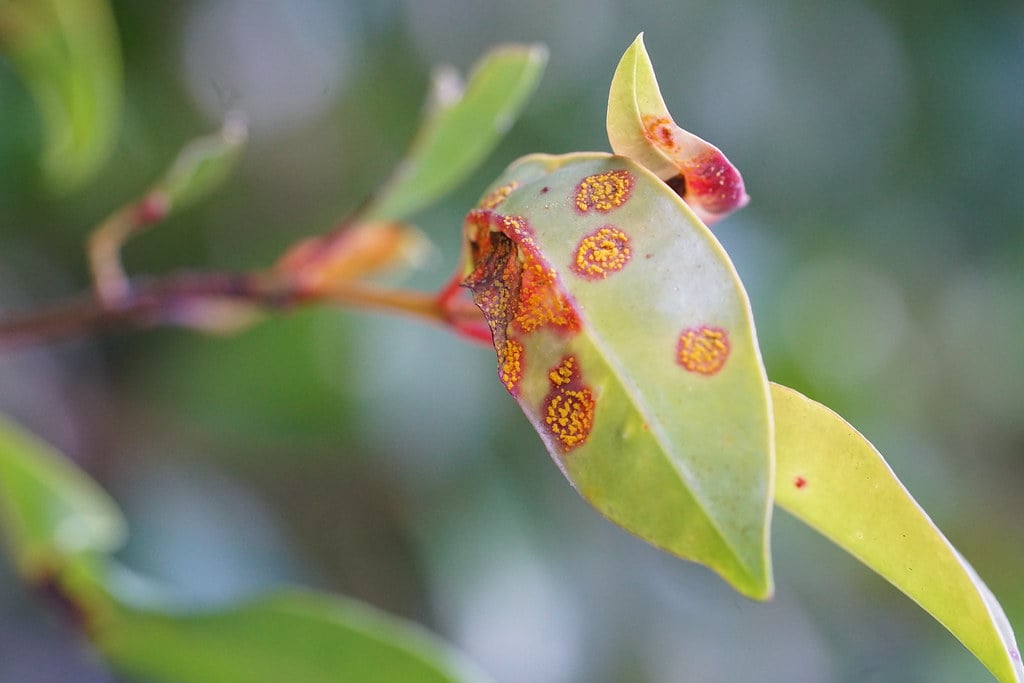
What should I look for? Check young growth for small dark lesions, yellow or orange pustules, powdery yellow spores, distorted young leaves, damaged shoots and dieback. Don't confuse the reddish or bronze colour of healthy new Lilly Pilly foliage with disease — healthy new growth should open normally and progressively mature, while rust produces lesions and pustules rather than simply colourful young foliage.
What should I do if I suspect Myrtle rust? Be careful about moving infected material around the garden. NSW guidance recommends measures designed to reduce spore movement when infected material is being handled or removed. Fungicide options exist, but the product must be approved for the situation and used according to its current label or applicable permit. For significant or uncertain symptoms, obtain a positive identification before beginning treatment.
5. Not enough water. Brown leaves don't automatically mean pests. Sometimes the hedge simply isn't getting enough water. A large established Lilly Pilly hedge has a substantial canopy and root system, and during extended dry or hot periods moisture demand can be considerable. Typical signs include brown leaf tips, brown margins, wilting, dry or crispy leaves, premature leaf drop and reduced new growth.
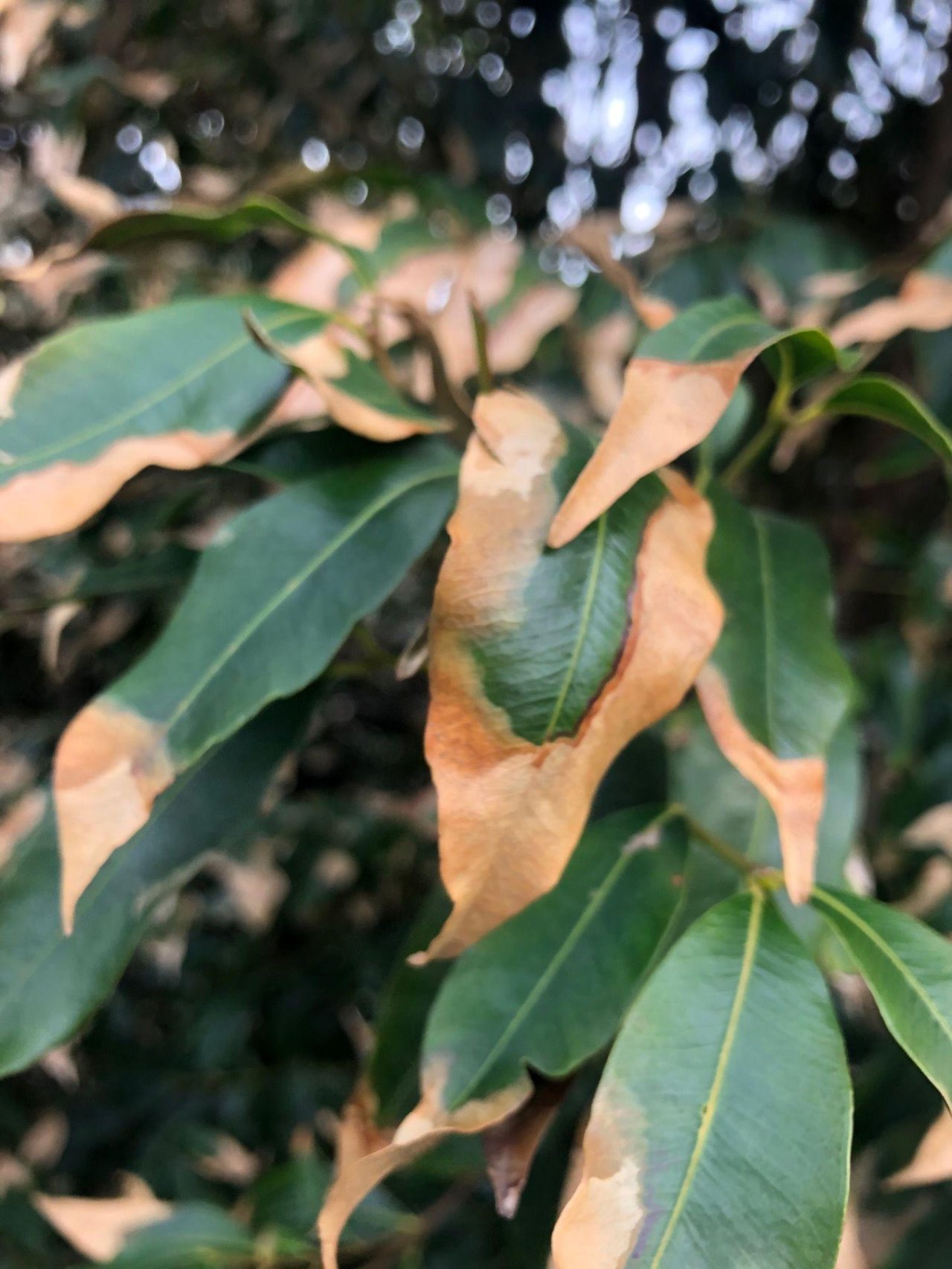
Don't judge soil moisture by the surface. The top few centimetres of soil can be misleading. Dig carefully into the soil around the root zone and check conditions deeper down. You may discover that irrigation is wetting only the surface while the main root zone remains relatively dry, which is particularly common with short, frequent watering. For established hedges, slower, deeper watering is generally more useful than repeatedly wetting only the soil surface. A layer of organic mulch helps conserve soil moisture and moderate soil temperature — keep it away from direct contact with the trunks, covering the root zone rather than burying the base of the plants.
6. Too much water and poor drainage. The confusing thing about waterlogged Lilly Pillies is that they can sometimes look as though they're too dry. Roots require oxygen, and when soil remains saturated for extended periods root function declines. A damaged root system then struggles to supply water and nutrients to the foliage, producing yellowing, browning, leaf drop, poor growth, branch dieback and generally weak plants.
Check where water goes after heavy rain. Does water pool around the hedge? Is the hedge at the bottom of a slope? Has drainage changed, or has soil been built up around the plants? Does irrigation continue running during wet weather? Sydney gardens vary enormously in soil type and drainage, so a watering schedule that works perfectly in one garden may be completely inappropriate in another. Don't simply add fertiliser to a waterlogged plant — first deal with the root environment, which may involve reducing irrigation, improving drainage, relieving soil problems or correcting changes around the root zone.
7. Root damage. If one section of an otherwise healthy hedge suddenly turns brown, look below ground as well as above it. Localised decline is often associated with root disturbance from excavation, new paving, retaining-wall work, trenching, plumbing, driveway construction, severe soil compaction or changes in soil level. A continuous hedge makes this particularly obvious: five plants may remain perfectly healthy while one or two suddenly decline. Before spraying those plants for pests, ask what changed around this part of the garden. The answer is sometimes underneath your feet.
8. Nutrient problems. Lilly Pillies are vigorous plants in suitable conditions. Nutritional problems can contribute to pale, yellow or weak foliage, but fertiliser shouldn't automatically be the first treatment for every unhappy hedge. If the root system is waterlogged, badly compacted or damaged, adding more fertiliser doesn't repair the underlying problem. Check soil moisture, drainage, root-zone condition, pests and disease first, then consider nutrition. For an established healthy hedge, an appropriate balanced fertiliser during active growth can support foliage and recovery — but avoid excessive fertiliser on a severely stressed plant. More isn't necessarily better.
9. Heat and hot westerly winds. Sydney summers can be hard on exposed hedges. A Lilly Pilly growing beside paving, masonry or a west-facing wall may experience much more heat than another hedge only a short distance away. Hot weather combined with dry soil and wind can result in leaf scorch, where the exposed side develops brown edges while the protected side remains relatively green. That pattern itself is a clue, so check irrigation coverage and soil moisture before assuming disease. In hot, exposed positions, tougher screening plants such as Murraya or Viburnum are sometimes a better long-term choice.
10. Has the hedge been cut back too hard? Heavy pruning can temporarily make a Lilly Pilly look much worse. A dense hedge hides its internal structure, so removing a large amount of exterior foliage suddenly exposes older stems and shaded interior growth. That isn't necessarily plant death. Lilly Pilly generally responds well to pruning when healthy, although recovery depends on plant health, season, water and the severity of the reduction — see what happens when a hedge is cut back too hard. After a substantial reduction, concentrate on creating good growing conditions rather than continually cutting the emerging foliage, and allow the hedge to produce enough healthy growth to rebuild its canopy.
11. Brown inside but green outside? This can be perfectly normal. Dense hedges intercept enormous amounts of light at the outer surface, so as the hedge becomes thicker very little light reaches the centre and old shaded foliage eventually yellows, browns and falls. If the exterior is vigorous, new shoots are healthy and there are no signs of pest or disease, some internal bare wood isn't necessarily a problem. Good pruning helps prevent the hedge becoming excessively wide and top-heavy.
How to diagnose a brown Lilly Pilly hedge. Before buying a spray or fertiliser, spend five minutes inspecting the hedge. Look at the newest leaves — distorted new growth points to psyllid. Turn the leaves over and look for scale, insects, spots and unusual growth. Check for stickiness and ants, which together with a black coating indicate sap-feeding insects and sooty mould. Look for yellow or orange pustules on damaged young growth, which suggest Myrtle rust. Then check the soil: don't just look at it, feel it below the surface. Very dry means investigating irrigation, continually saturated means investigating drainage.
Look at the pattern. This is one of the best diagnostic tools. If the whole hedge is affected, consider weather, irrigation, nutrition or widespread pest pressure. If one plant is affected, investigate that plant's roots. If one side is affected, consider sun, wind, reflected heat or irrigation coverage. If only new growth is affected, look closely for pests or disease. If only the interior is affected, consider shading and normal leaf turnover.
A simple treatment plan. Once you've identified the likely cause, treatment becomes much more logical. For psyllid, control the pest, remove badly damaged foliage where appropriate and protect healthy replacement growth. For scale and sooty mould, treat the underlying sap-feeding insect rather than focusing solely on the black mould. For Myrtle rust, avoid unnecessarily spreading infected material and use only appropriate approved treatment and disposal methods. For drought stress, correct irrigation and use mulch to improve moisture retention. For waterlogging, reduce excess water and address drainage before adding fertiliser. For root damage, remove the source of stress where possible and give the plant time and suitable conditions to recover. For nutrient issues, correct the growing conditions first, then provide appropriate nutrition during active growth.
Should I cut all the brown leaves off? Not automatically. A few damaged shoots can usually be removed without issue, but if most of the hedge is affected, stripping away large quantities of foliage can place additional stress on an already weakened plant. First identify and correct the cause, then prune according to the plant's condition and ability to recover. With pest-damaged foliage, pruning can be useful because the old distorted leaves won't repair themselves. With severe environmental stress, a more conservative approach may be appropriate until the root system and water balance improve.
Will my brown Lilly Pilly hedge recover? Often, yes. Lilly Pillies can be resilient hedging plants. The important question is whether the underlying cause has been corrected. A hedge repeatedly attacked by pests, sitting in saturated soil or receiving inadequate water won't recover properly simply because the brown foliage has been cut away. Once the cause is corrected, watch the new growth — that's often the best measure of recovery. Healthy, correctly formed new leaves are a much better sign than the appearance of old damaged foliage.
Keeping Lilly Pilly hedges healthy. Prevention is considerably easier than recovering a badly stressed hedge. A good maintenance program includes regular inspection of new growth, appropriate watering, free-draining soil, organic mulch, appropriate nutrition, regular trimming, monitoring for psyllid and scale, and avoiding unnecessary damage around the root zone. Pay particular attention to the hedge during periods of vigorous new growth — problems are much easier to deal with when you spot the first few damaged shoots rather than waiting until a large section of the hedge has deteriorated.
Need help with a Lilly Pilly hedge? If your Lilly Pilly is turning brown, becoming patchy or producing distorted foliage, identifying the cause should come before treatment. At Hedge Sydney, we maintain Lilly Pilly hedges throughout Sydney and can assess the condition of the hedge as part of its ongoing care. For hedges that have simply become too large, we can also advise whether regular trimming or a staged hedge reduction is the better approach. If you're establishing a new screen, see our Lilly Pilly hedging plants for information on plant sizes, spacing and establishing a dense hedge. Send us photographs of your hedge and request a quote.