Weeds pushing through driveways, pathways, gravel beds and commercial hardstand areas are more than an eyesore. They crack paving, trip pedestrians, trap litter and moisture, and make an otherwise tidy property look neglected. The frustrating part is that a single spray rarely solves the problem: kill the weeds you can see and a fresh crop germinates from the seed bank in the soil within weeks. Effective long-term control on large areas comes from combining two types of herbicide — post-emergent and pre-emergent — on a planned schedule.
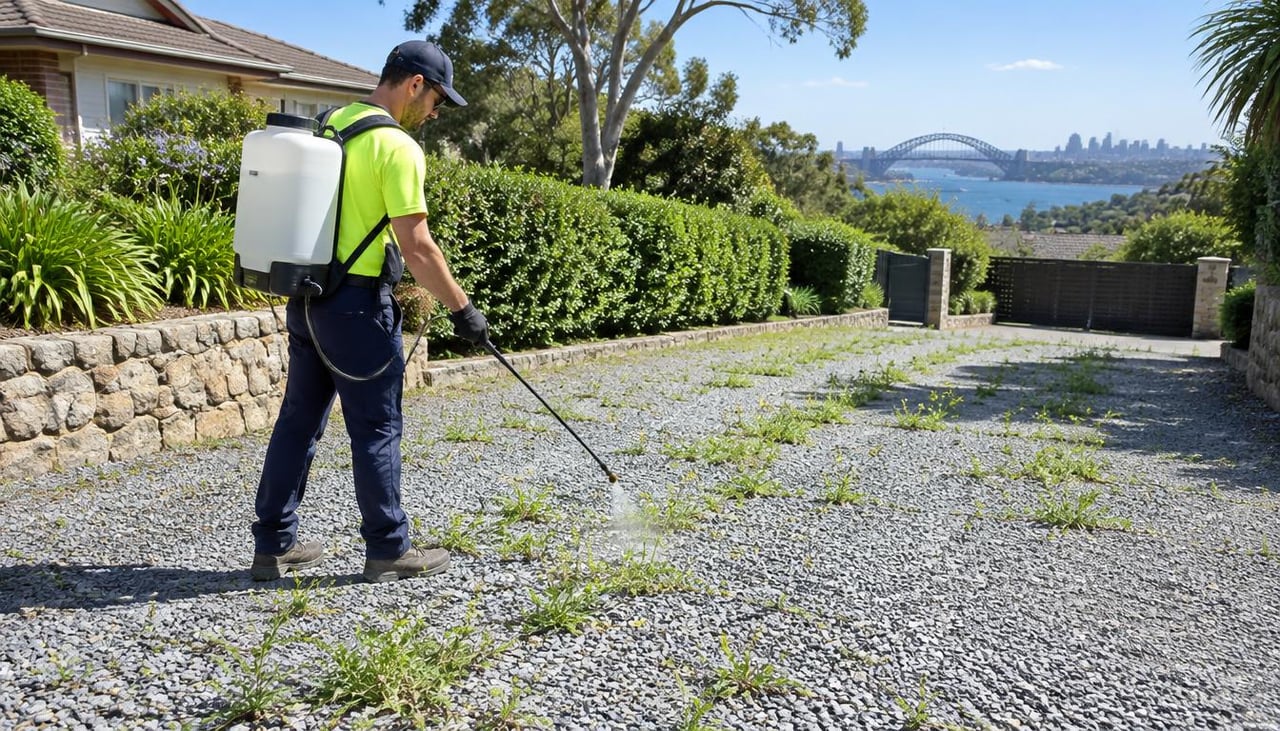
Post-emergent herbicides are the products that kill weeds which have already germinated and are actively growing. They are absorbed through the leaves and either burn the foliage down on contact or move through the plant to kill the roots. On hard surfaces the most common choice is a non-selective post-emergent, because anything growing through a driveway or gravel bed is a weed by definition. For best results, spray when weeds are young and actively growing, on a calm, dry day with no rain forecast for at least six hours. Mature, seeding or drought-stressed weeds take longer to die and often need a follow-up pass two to three weeks later.
Pre-emergent herbicides work completely differently. Rather than killing existing weeds, they form a treated layer in the top of the soil or gravel that stops weed seeds from successfully germinating. Applied to a clean surface, a quality pre-emergent can prevent new weeds for three to six months, which is what turns endless spot-spraying into genuine long-term management. Pre-emergents must be watered in or applied before rain to activate, and they do nothing to weeds that are already up — which is why the two product types are always used together.
The proven program for large areas is straightforward. First, treat the entire area with a post-emergent herbicide to knock down every existing weed, and allow ten to fourteen days for a full kill. Second, once the surface is clean, apply a pre-emergent across the whole area to lock down the seed bank. Third, inspect every six to eight weeks and spot-treat any breakthrough weeds while they are small, before they set seed and restart the cycle. On gravel driveways and commercial hardstand, reapplying pre-emergent every four to six months — typically late winter and late summer in Sydney — keeps the barrier intact year-round.
| Post-emergent | Pre-emergent | |
|---|---|---|
| What it does | Kills weeds that are already growing | Stops weed seeds germinating |
| When to apply | On actively growing weeds, calm dry day | On a clean surface, before germination flushes |
| How long it lasts | Kill in 1-2 weeks; no residual protection | 3-6 months of prevention |
| Sydney timing | October-April for fastest results | Late Aug-Sep and late Feb-Mar |
Timing matters as much as product choice. In Sydney, the two big germination flushes are early spring, when winter annuals and summer grasses strike, and autumn, when winter weeds germinate. Scheduling your pre-emergent applications just ahead of these flushes — late August to September and again in late February to March — stops the bulk of weeds before they appear. Post-emergent follow-ups work best in the active growing season from October through April; winter spraying is slower because cold weeds metabolise herbicide poorly.
There are important safety and legal considerations on larger jobs. Herbicides used around commercial premises, strata complexes, schools and public pathways must be applied by appropriately licensed and accredited operators, with correct signage, re-entry periods and records of what was applied, where and when. Drift onto lawns, garden beds or neighbouring properties can cause serious damage, so calibration, nozzle selection and wind conditions all matter. Hedge Sydney holds commercial spray accreditation, which means we are qualified and insured to carry out herbicide application on commercial sites, body corporate properties and large residential areas — not just small garden beds.
| Visit | Timing | What happens |
|---|---|---|
| Initial knockdown | Week 1 | Post-emergent spray over the whole area |
| Clean-up check | Week 2-3 | Spot-treat survivors; remove dead growth |
| Pre-emergent barrier | Week 3-4 | Pre-emergent applied to the clean surface |
| Maintenance | Every 6-8 weeks | Inspect and spot-treat breakthrough weeds |
| Barrier renewal | Every 4-6 months | Reapply pre-emergent ahead of seasonal flushes |
Non-chemical measures still have a place in the program. Keeping gravel topped up to a depth of 50–75 mm smothers many germinating seeds, sweeping pathways removes the dust and organic matter weeds root into, and fixing drainage removes the damp pockets where weeds establish first. But on any area of reasonable size, mechanical removal alone cannot keep pace with the seed bank — a combined spray program is far more cost-effective over a year than repeated hand-weeding or pressure cleaning.
If you manage a commercial property, strata complex or a large residential driveway and weeds keep coming back, the answer is a scheduled program rather than another one-off spray. Hedge Sydney can assess the site, clear existing weeds with post-emergent treatment, apply pre-emergent protection and return on a maintenance schedule so the area stays clean. Visit our garden clean-up page for related services, or get in touch for a free quote and we will put together a tailored weed management plan for your property.