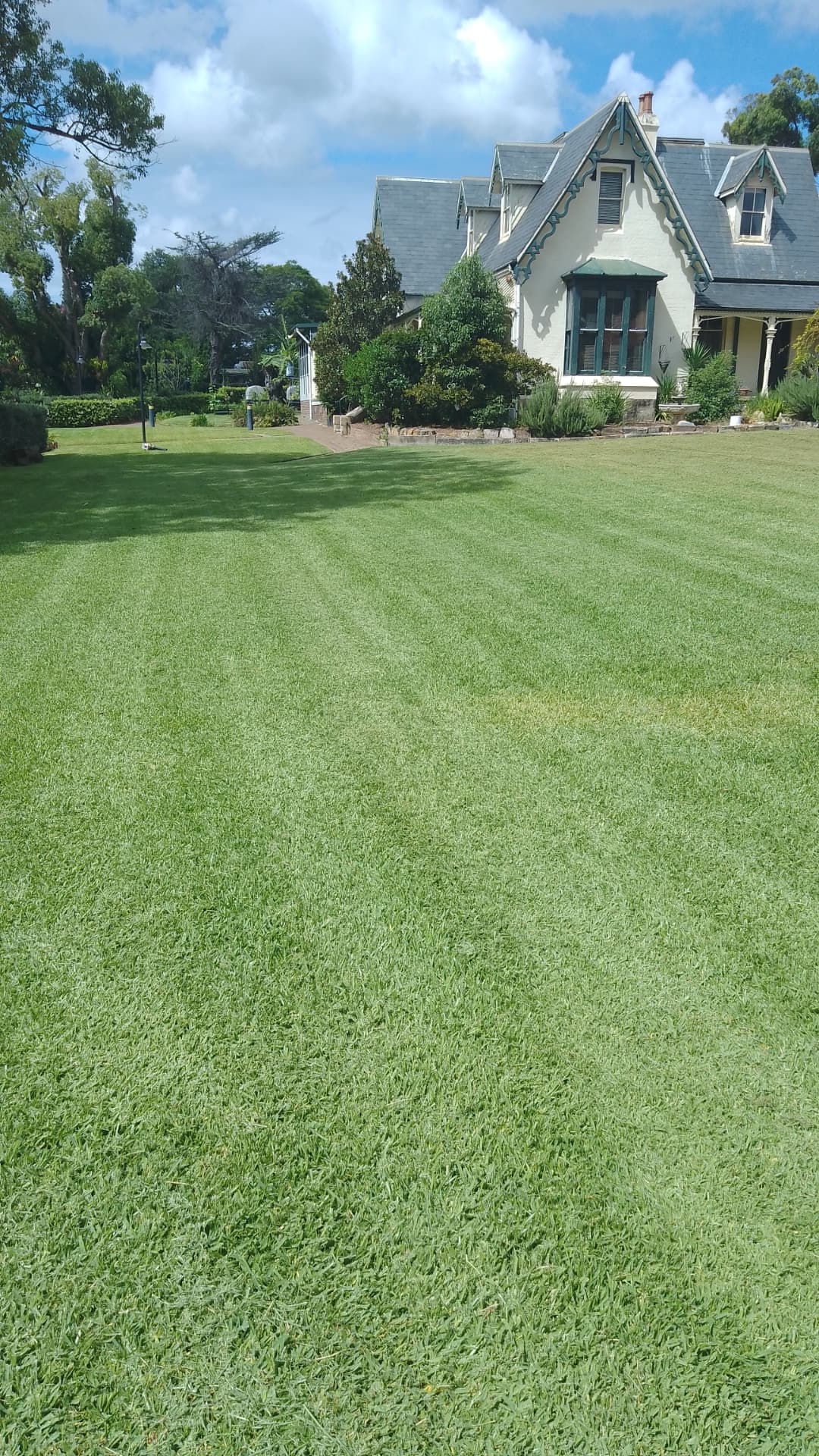
Buffalo is one of the most popular lawn varieties in Sydney. It tolerates shade, handles heat well and stays green longer through dry spells than many warm-season grasses. But its broad, soft leaves need a different mowing approach than finer grasses such as Couch or Kikuyu.
During the active growing season, from late spring to early autumn, mow a Buffalo lawn every 10 to 14 days. In peak summer, when growth is fastest, a weekly cut may be needed to keep the lawn looking tidy. In winter, growth slows dramatically, so extending to every three or four weeks is usually enough.
The golden rule is never to remove more than one-third of the leaf blade in a single mow. Cutting too low stresses the plant, thins the lawn and opens the door for weeds. If the lawn has grown long, raise the cut height and take it down gradually over two or three mows rather than scalping it in one go.
Keep your mower blades sharp, water deeply but infrequently, and apply a slow-release lawn fertiliser in spring and autumn. A consistent mowing schedule keeps Buffalo thick, soft underfoot and resistant to weeds and disease.
Buffalo grows by above-ground runners rather than underground rhizomes, and that single fact explains most of its mowing needs. Because the growing points sit up on the stolons rather than protected at soil level, a low cut removes them and the lawn browns off and recovers slowly. Skipping mows lets the runners layer over one another and build thatch, which is why a Buffalo lawn that has been left for a month often looks spongy and uneven even after it is cut back.
Adjust the interval for shade and season rather than sticking to a fixed date. In shaded sections, mow less often and higher — the grass needs more leaf area to survive on limited light. Growth also responds sharply to rain and warmth, so a wet, warm week in February may need a cut in seven days while a dry one needs none. A practical test is to mow whenever the lawn has grown about a third above your target height, rather than by the calendar.
Small habits produce the biggest visual difference. Mulch-mow and leave the clippings when they are short, which returns nitrogen and cuts fertiliser needs, but catch them when the lawn has grown long or is wet. Alternate your mowing direction each visit to stop the runners laying flat in one direction, keep the blades sharp so the broad leaf is sliced rather than shredded, and dethatch or verticut in spring if the thatch layer exceeds about 20 mm. Combined with a spring and autumn feed, this routine keeps Buffalo dense enough to crowd out most weeds without herbicide.